
| Manufacturer | Umarex (Germany) / Prepared 2 Protect |
| Launcher Type | Pistol — semi-automatic |
| Power Source | CO₂ — 12g cartridge (grip-seated) |
| Caliber | .50 caliber (not .68 compatible) |
| Projectiles | Rubber balls, nylon, chalk/powder, PAVA pepper balls (.50 cal) |
| Weight | 1.5 lbs unloaded |
| Barrel Length | 4 inches |
| Rail System | Picatinny (underbarrel) |
| Best Suited For | Budget-conscious buyers who want proven T4E reliability — best entry point in the T4E lineup |
Design & Build Quality
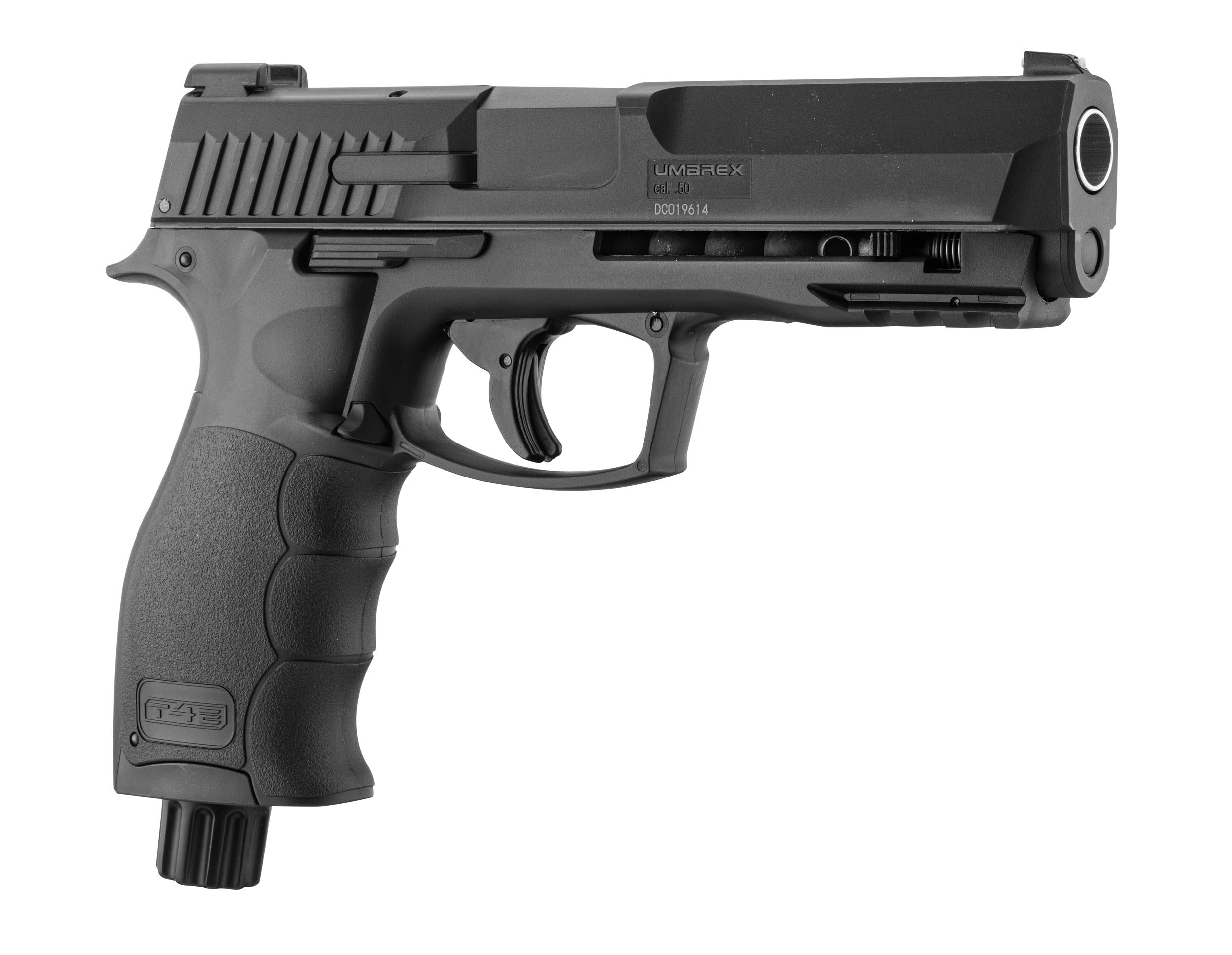
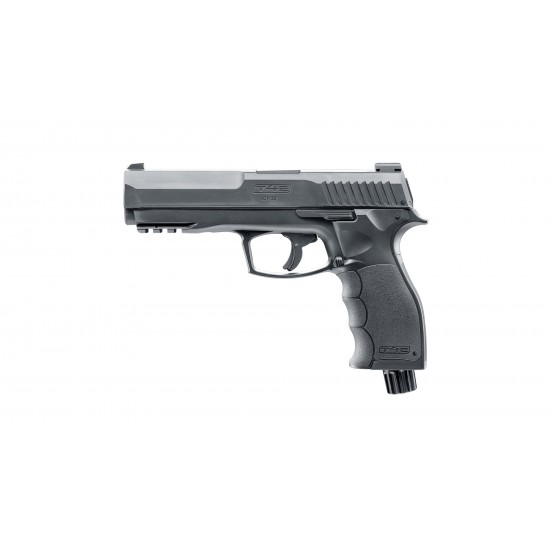
The HDP 50 is Umarex’s proven T4E engineering at the most accessible price point. The frame is glass-filled polymer with a metal barrel liner and internal components at the valve assembly and magazine tube. At 1.5 lbs and 4-inch barrel, it’s compact and handles well. The profile is intentionally pistol-like — no exposed CO₂ cylinder, no external magazine well that reads as “paintball marker.” The underbarrel Picatinny rail accepts standard lights and lasers, giving the HDP 50 a tactical capability that some more expensive consumer platforms don’t offer.
The internal tube magazine holds 6 rounds under the barrel in a spring-fed format. This is a slower reload system than a drop-free box magazine: rounds are loaded one at a time from the muzzle end of the tube. In a defensive scenario, carrying the HDP 50 with a fully-loaded tube and a spare speedloader or pre-loaded tube is the standard approach. Build quality is consistent with T4E’s reputation: the platform is used by European law enforcement training programs, which sets a baseline expectation for durability that consumer-grade alternatives often don’t meet.
Performance & Ballistics
The HDP 50’s 485 FPS muzzle velocity is notably higher than most .68 cal competitors at this price — the smaller .50 cal projectile accelerates faster from the same 12g CO₂ gas volume. At 13 joules, the kinetic energy is slightly lower than a .68 cal 17-joule platform, but the higher velocity means a flatter trajectory and better performance at the far end of the 60-foot effective range. For kinetic impact at 15–45 feet, a 13-joule .50 cal round delivers meaningful deterrence.
A notable aftermarket mod significantly changes the HDP 50’s performance profile: the high-power valve upgrade (available from Z-RAM, MCS, and others) can push the HDP 50 substantially beyond stock output. With a reinforced valve installed, the HDP 50 transitions from a budget entry-level platform to a capable mid-tier launcher. This upgrade path is well-documented in the T4E community and is one of the platform’s most compelling attributes given the low initial cost.
CO₂ System
The HDP 50 uses a standard grip-seated 12g CO₂ cartridge. At stock power settings, approximately 20–25 shots per cartridge at 70°F — higher than many .68 cal competitors because the .50 cal projectile and lower output setting draws less gas per shot. The CO₂ cartridge must be pierced before use via a seating screw in the grip; unlike Byrna’s Pull-Pierce or P2P’s Response Ready Trigger, there is no single-motion activation.
Standard 12g cartridges from any supplier are compatible. Cold-weather performance degrades predictably with all CO₂ systems. For home defense staging, the HDP 50 is best kept indoors at ambient temperature with a pre-seated and pierced cartridge for immediate readiness.
Projectile Compatibility
The HDP 50 is .50 caliber — an important compatibility note for buyers who own or plan to own other less lethal platforms. The majority of the less lethal market is .68 caliber; .50 cal projectile selection is narrower, though not limited. Umarex and P2P both supply .50 cal T4E rubber balls, nylon rounds, chalk/powder rounds, and PAVA pepper balls for the HDP 50. Third-party .50 cal paintball rounds are also compatible, expanding the ammo supply chain.
PepperBall’s LifeLite system uses .50 cal projectiles, making PepperBall LIVE SD and VXR rounds compatible with the HDP 50 bore. This is a meaningful compatibility win: PepperBall’s PAVA rounds are among the most well-documented and tested projectiles in the civilian less lethal market, and accessing them via the HDP 50 provides a significant capability upgrade over basic rubber ball use.
Known Issues & Limitations
- .50 caliber projectile selection is narrower than .68 cal — fewer specialty round options from third-party vendors.
- Internal tube magazine reloads more slowly than a drop-free box magazine; pre-loaded spare tubes improve operational readiness.
- Not compatible with .68 caliber rounds — creates a separate supply chain from most of the less lethal market.
- Stock 13-joule output is adequate but modest; valve upgrade is recommended for users who want a more capable defensive platform.
Accessories & Upgrade Ecosystem
- .50 cal rubber balls, PAVA pepper balls, chalk/powder rounds (T4E/P2P product line)
- Picatinny rail light or laser (underbarrel)
- High-power valve upgrade (most impactful mod — widely available)
- P2P defense kit bundles
- 12g CO₂ cartridge multi-packs
- Speed loaders for tube magazine
Platform Summary
The T4E HDP 50 earns its place as the best entry point into the T4E less lethal family at under $170. T4E build quality — proven in European law enforcement training — is a genuine differentiator at this price tier. The 485 FPS velocity, Picatinny rail, and high-power valve upgrade path give the HDP 50 more upside potential than most budget competitors.
The tradeoffs are real but manageable: .50 cal narrows your ammo selection vs. the broader .68 cal market, and the tube magazine is slower to reload under pressure. For buyers who want a capable bedside or vehicle backup without committing more than $170, and who are willing to invest in a valve upgrade, the HDP 50 is the strongest value proposition at its price point.